
 Rick Wainschel, VP Data Science & Analytics
Automotive Digital Marketing Solutions: Digital Advertising and SEO
Long before they reach your lot, shoppers are seeing your inventory in ads and searching for answers online. This guide shows how digital...
At the start of this year, we outlined a straightforward expectation in the our Q1 State of the Industry report: 2026 was likely to be a tougher year to sell cars. Consumer confidence was softening, affordability was already stretched, and pricing remained elevated by historical standards.
What we’re seeing now adds another layer of complexity. Prices aren’t stabilizing—they’re rising again.
As of March 25, 2026, the average marketed price has climbed to $50,373, its highest level since June 2024. It has increased by $749 over the past 30 days and sits $965 higher than a year ago.
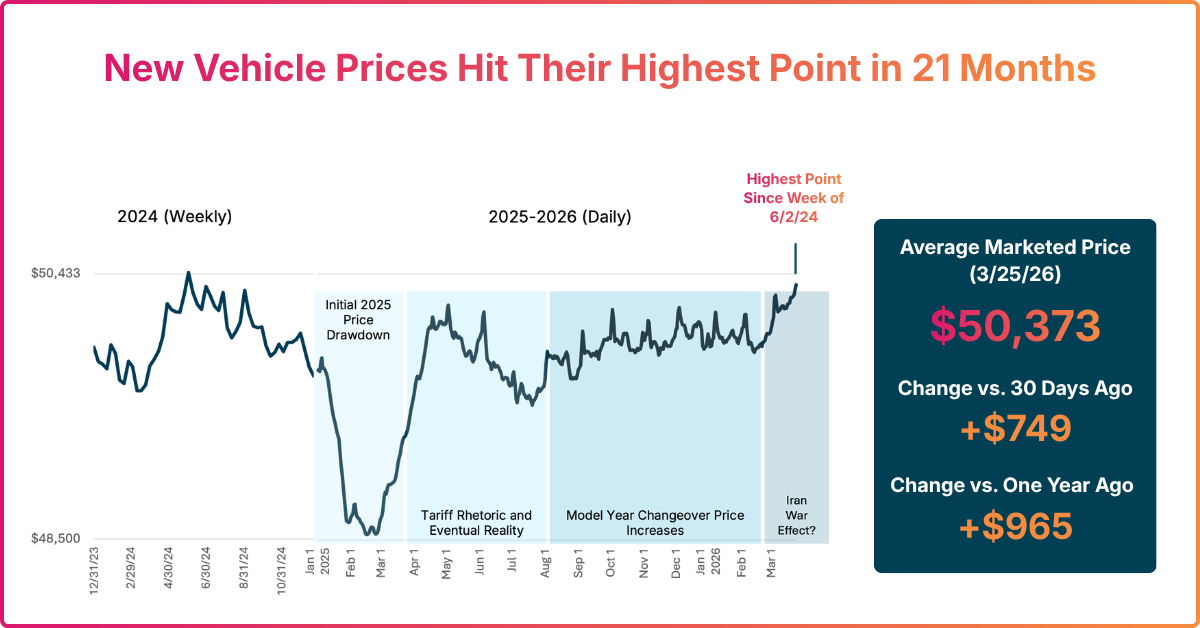
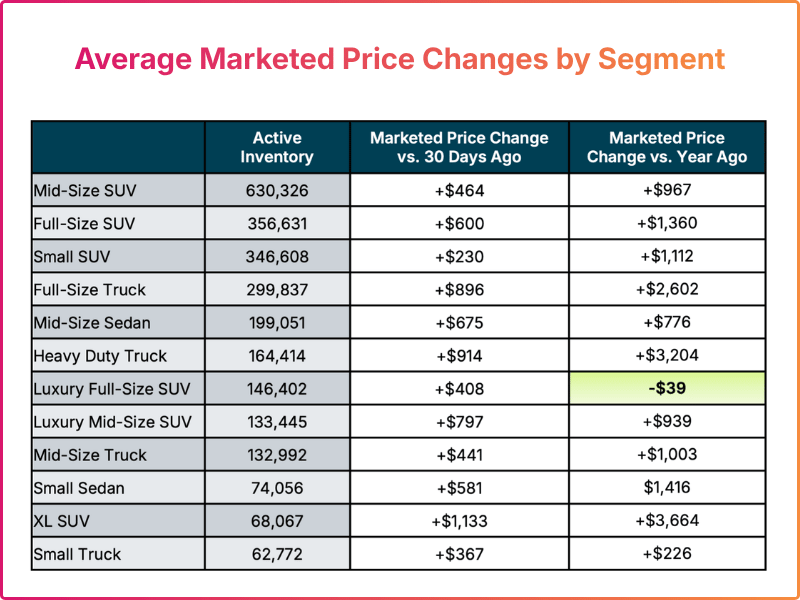
This metric reflects what consumers actually see when they shop, incorporating visible discounts and incentives across dealer websites and listings. In practical terms, the car-buying experience is getting more expensive again.
If prices were rising alongside strong demand, this would be a different conversation. Instead, they are increasing in a more fragile environment, where affordability constraints are already limiting the market.
That dynamic is inherently restrictive. As prices move higher, more consumers are pushed to the sidelines, purchase timelines extend, and inventory performance becomes increasingly uneven. Over time, that leads to longer days-to-sale and a growing divide between vehicles that move quickly and those that do not.
Several factors are converging. Cost pressures are working into pricing strategies, while model year changeovers are introducing newer inventory with more aggressive tariff-related increases built in. Incentive discipline has also returned after a more aggressive 2025, and broader geopolitical uncertainty may be influencing both cost expectations and pricing behavior.
Regardless of the exact mix, the result is the same: higher prices in a market that is not set up well to fully absorb them.
As conditions tighten, variability increases at the vehicle level. Some units remain well-positioned and sell quickly, while others begin to age—often without clear visibility into why.
At the same time, many strategies remain broad. Incentives are applied at the model level, and marketing is distributed evenly across inventory. This approach can lead to over-supporting vehicles that would sell anyway, while under-supporting those that actually need help.
In this environment, success depends on precision. Identifying which specific VINs are at risk—whether due to pricing, competition, or visibility—allows for more effective and efficient intervention.
Targeted marketing and incentive support can then be directed where they are most likely to influence outcomes, improving turn without unnecessarily compressing margins across the board. This shift from broad strategy to VIN-level execution becomes increasingly important as market conditions grow more complex.
Rising prices in a softening demand environment are a signal worth paying attention to. They introduce greater friction into the market and increase the importance of execution. In this context, broad strategies lose effectiveness. Precision matters more.
For dealers and OEMs, the ability to identify which vehicles need support—and act on that insight—will be critical to navigating what comes next. That’s where a more targeted, VIN-level approach can make a meaningful difference.

About Catalyst IQ
Catalyst IQ is an integrated automotive marketing platform that helps dealerships make smarter decisions and sell more cars using real-time data, AI-powered insights, and expert human support. From digital advertising and web presence to SEO/AEO and engagement, every solution works together to drive measurable growth.

Long before they reach your lot, shoppers are seeing your inventory in ads and searching for answers online. This guide shows how digital...

Model Year Changeover season is here. And for dealers, waiting to support 2026s could come with a significant price tag. We are officially...

No one can tell you what your dealership's marketing will cost before looking at your market. What you spend depends on your local competition,...