
 Rick Wainschel, VP Data Science & Analytics
Automotive Marketing in 2026: Channels, Tactics, and What’s Working for Dealers
Every marketing dollar should help your dealership sell cars. But with more ways than ever to reach shoppers, deciding where your money will...
Buyers didn't leave the automotive market in Q1 2026. They made different choices, and those choices are reshaping what a successful dealership looks like right now.
Facing higher vehicle prices, rising gas costs, and growing uncertainty about their own finances, consumers shifted toward vehicles that fit their budgets today rather than the ones they might have considered a year ago. Used and certified vehicles picked up that demand, while new vehicles absorbed the loss.
The market is still active, but where the opportunity sits has shifted. If you're still operating the way you were a year ago, the Q1 data suggests it's worth taking a hard look at why results may not be following.
.png?width=1125&height=1125&name=2026ReportDisplaySquare3%20(1).png)
Dealers spent the first quarter discounting aggressively and watching velocity fall anyway. The discounting didn't work, however, because a growing number of buyers already decided they wanted a more affordable used or certified vehicle instead.
Price adjustments on new inventory aren't reaching buyers who have moved on to a different part of the market. For the rest of 2026, the more important conversation is whether the inventory mix reflects where buyer demand has actually gone.
Used vehicles are where buyer demand landed. Buyers gravitating toward used aren't doing so reluctantly. They're choosing it because the price point works for them right now, and the segments seeing the strongest shift from new to used are non-luxury mid-size SUVs, small SUVs, and trucks.
In each of those categories, used and certified versions are moving faster while new vehicle sales have slowed. Dealers with strong used inventory in those segments are in the best position to capture that demand.
Certified vehicles are picking up demand from buyers who want more assurance than a standard used vehicle offers but can't justify the price of new. That middle ground is more valuable right now than it's been in years.
Faster turns are one benefit, but certified is also keeping buyers connected to the brand. Rather than drifting toward independent used inventory, buyers who choose certified stay within a brand they already trust.
Dealers who invest in their certified programs now are building a channel that serves them well as long as affordability remains the deciding factor.
Consumer confidence has been falling for two years, and new vehicle prices aren't coming down to meet buyers where they are.
After a period of relative stability, average marketed prices started rising again and recently reached their highest point since October 2023. When prices go up and confidence goes down at the same time, buyers don't stop shopping. They shop for something different.
.png?width=1200&height=628&name=What%20Changed%20in%20the%20Automotive%20Market%20in%20Q1%202026%20(1).png)
For dealers, this environment rewards simplicity. Buyers who are watching their monthly budgets closely need a clear answer to what a vehicle will actually cost them. Selling strategies that lead with payment and value will convert better than those built around discount complexity.
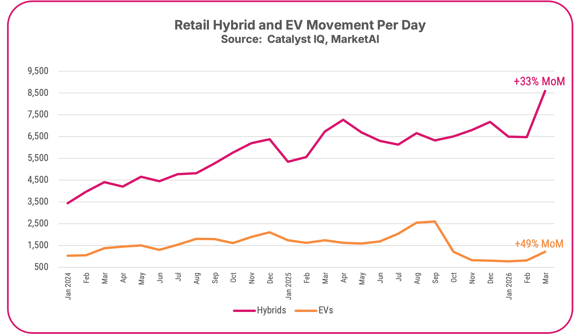
When gas prices rose sharply in March 2026, buyers responded quickly. Hybrids were already gaining momentum heading into the year, and the spike pushed more buyers across the decision threshold. Dealers with strong hybrid inventory are seeing faster turns, and clear communication about real-world fuel savings is helping convert buyers who are still weighing their options.
EVs are recovering from the sharp drop that followed the elimination of the federal EV tax credit in late 2025, but the recovery is uneven. The buyers most likely to purchase an EV right now are those who've already decided they want one.
Broad EV promotion across all inventory isn't the most efficient use of marketing spend. Focusing on the markets and buyer profiles where EV adoption is already strongest will produce better results.
Q1 results looked different depending on where a dealer operates, and that gap is only going to widen as national trends become less useful for making local decisions.
Used and certified vehicle movement rose quarter over quarter in every major market tracked, but the gains ranged from modest to significant depending on location.
New vehicle movement fell in most markets, with the steepest year-over-year declines concentrated in Boston and Seattle.
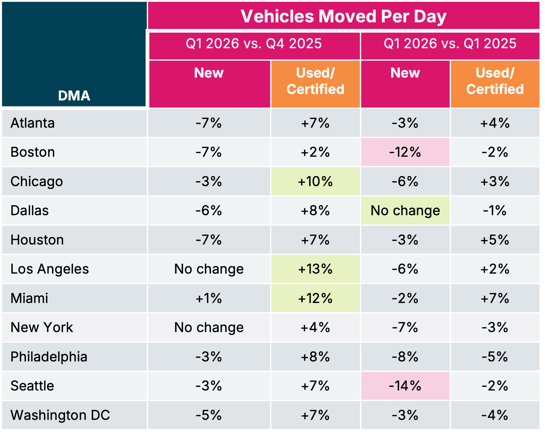
What this means practically is that the same inventory mix, pricing strategy, or incentive program can produce very different results depending on where a dealer operates.
A national benchmark tells you what's happening across thousands of stores, but it doesn't tell you what's happening on your lot, in your market, against your specific competitors.
Dealers who are making decisions based on local demand data, rather than waiting for national trends to catch up, are better positioned to act before conditions shift further.
The dealers who come out of 2026 in the strongest position won't be the ones who waited for the market to return to what it was. They'll be the ones who recognized the shift early and made deliberate decisions about where to focus.
Q1 pointed to three areas where acting sooner rather than later makes a measurable difference.
Rebalance toward used and certified. Used and certified vehicles are turning faster than new across most segments, and dealers weighted heavily toward new are sitting with slower-moving units and growing pressure to discount. Getting the mix right starts with sourcing. Trade-ins, off-lease vehicles, and auction strategy all become more critical when buyer demand is running ahead of what naturally comes through the door.
Get ahead of aging inventory. Addressing slow-turning new vehicles before they require deep discounting gives dealers more options and more margin to work with. Waiting until the end of a quarter makes every option more expensive, and incentive spend should reflect that. Units already moving well locally don't need the same level of support as those that are aging.
Adjust for longer decision cycles. Buyers are comparing more carefully and taking longer to commit. Consistent follow-up matters more than it did when the market moved faster. A buyer who doesn't respond immediately isn't gone. They're still deciding.
Q1 pointed to three areas where OEMs may need to recalibrate.
Align production with actual demand. New vehicle demand is softer than it was a year ago, and deeper incentives aren't bringing buyers back. Aligning production and allocation with what retailers are actually selling reduces the risk of inventory building up to a point where costly clearance programs become the only way to move it.
Strengthen certified programs. When buyers trade down from new, a strong certified program gives them a reason to stay with the brand rather than shopping independent used inventory. Dealers are better equipped to retain those buyers when OEMs back them with better data, stronger residual value management, and clearer program support.
Build in regional flexibility. National incentive and allocation programs are less effective when different markets are experiencing meaningfully different demand conditions. Giving dealers better access to local data and the tools to act on it produces more efficient results across a diverse set of markets.
Q1 showed how quickly the gap widens between dealers who are aligned with current demand and those who aren't. Dealers seeing the strongest results are acting sooner, identifying which vehicles need attention, where pricing support makes sense, and how well their inventory matches local buyer demand rather than making broad changes across the entire lot.
MarketAI supports this type of focused approach. It helps dealers see which vehicles are falling out of line, track how local demand is changing, and prioritize pricing and marketing actions at the VIN level. This allows teams to move based on what is happening in their market, not national averages or last-minute adjustments.
For dealers who want to apply what Q1 revealed to their own inventory, a MarketAI demo shows how these signals translate into everyday decisions around pricing, marketing focus, and inventory risk. Click the button below to see how it works.


About Catalyst IQ
Catalyst IQ is an integrated automotive marketing platform that helps dealerships make smarter decisions and sell more cars using real-time data, AI-powered insights, and expert human support. From digital advertising and dealership web presence to SEO and AEO for dealerships, and engagement, every solution works together to drive measurable growth.

Every marketing dollar should help your dealership sell cars. But with more ways than ever to reach shoppers, deciding where your money will...

Ford and Lincoln dealers gain direct access to spot opportunities sooner, make smarter advertising decisions, and sell more vehicles, faster.

When a car shopper asks AI where to buy or service a vehicle, only a few dealerships may make the list of recommendations. Find out whether...