
 Rick Wainschel, VP Data Science & Analytics
Automotive Marketing Solutions: Digital Advertising and SEO
Long before they reach your lot, shoppers are seeing your inventory in ads and searching for answers online. This guide shows how digital...
Labor Day weekend—and the sales events that come with it—are right around the corner.
For dealers, that means another opportunity to turn inventory into sales. But with vehicle prices high and profitability under pressure, where you put your marketing dollars matters even more than usual.
That's where precision marketing comes in. But what does "precision" actually mean?
It starts with understanding that not every vehicle on your lot is facing the same market conditions. Some vehicles are in high demand and may need little marketing support. Others may require a more targeted effort to connect with the right buyers.
The key is identifying where your biggest opportunities exist and focusing your resources accordingly. To do that, dealers need to look at the market from a few different perspectives, moving from broad trends all the way down to the individual VIN.
Before deciding what to do with the vehicles on your lot, it helps to understand the environment the brand is operating in. Some brands are benefiting from strong demand. Others are facing more resistance in the market.
Our Inventory Efficiency Index (IEI) score helps provide that context. A score of 100 means a brand's market share and inventory share are in balance. Below 100 means the brand isn't getting its fair share given its inventory position; above 100 means it's getting more than its fair share.
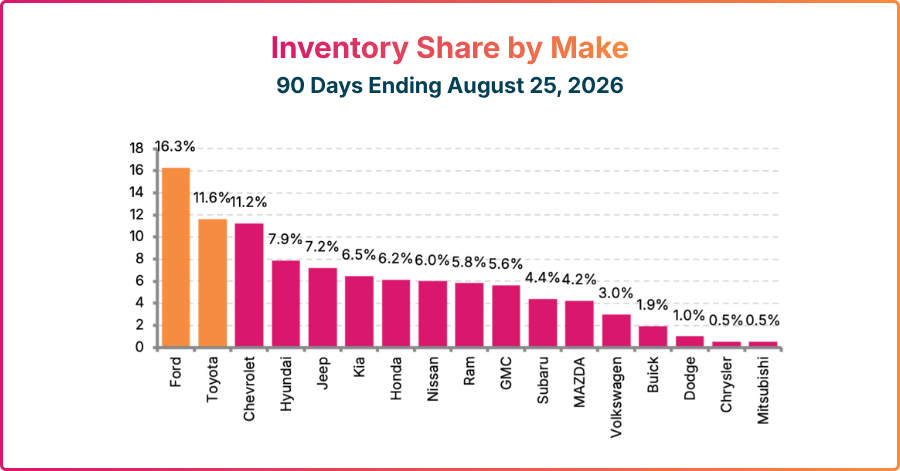
At the national level, Ford and Toyota tell two very different stories.
.png?width=900&height=471&name=Automotive%20marketing%20agency%20(2).png)
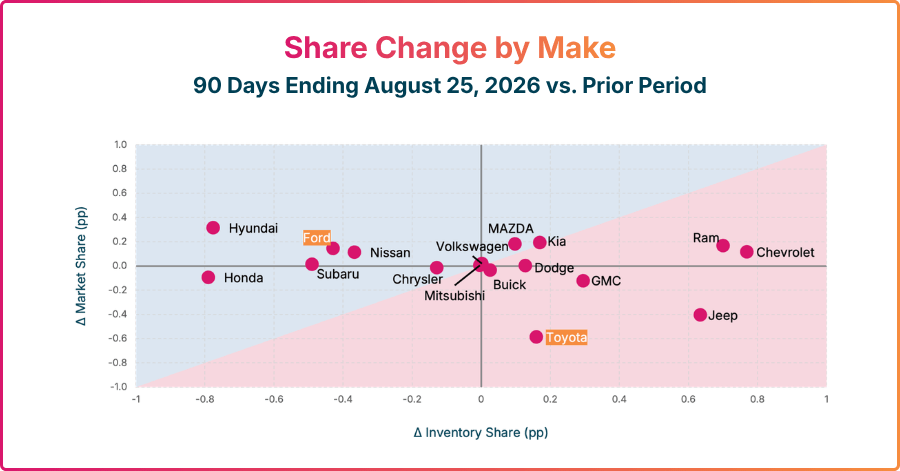
Ford's IEI score is 84, putting it below the level where its inventory position would suggest it should be. But the trend is improving.
Ford's market share trajectory is moving in the right direction relative to its inventory trajectory, suggesting its efficiency is improving.
That's important context if you're a Ford dealer. The brand still faces challenges, but it's in a better position than it was a few months ago.
Toyota is almost the opposite story. Its IEI score is 145, meaning the brand is generating significantly more market share than its inventory position would suggest. That's still a strong position, but its efficiency has declined slightly from the previous period.
If you're a Toyota dealer, the goal isn't to solve a brand-level problem. It's to understand where performance may be starting to soften.
.png?width=900&height=471&name=Automotive%20marketing%20agency%20(1).png)
Brand-level performance gives you the context. Model-level performance tells you where to focus.
For Ford, the answer isn't simply “market Ford harder.” Most importantly, the brand's improving trajectory means you can start looking for the parts of the lineup that need more help.
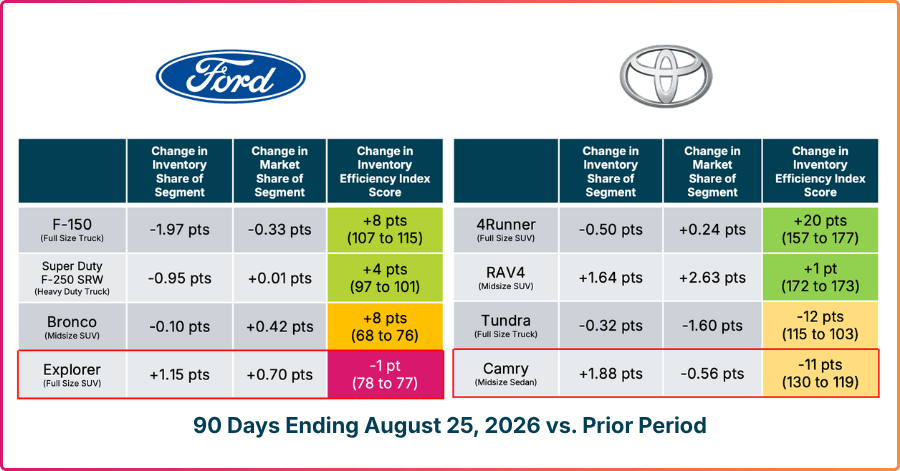
The Explorer stands out. Its IEI score within the full-size SUV segment is 77 and declining, even as both inventory share and market share are increasing. That's a very different marketing proposition than the Ford brand as a whole.
While Ford's overall performance is improving, the Explorer is not improving at the same rate. That's where a dealer can begin shifting attention toward the vehicles that need it most.
Toyota presents a similar but slightly different story. The Camry remains highly efficient, with an IEI score of 119, but that number has fallen 11 points in the current period. Meanwhile, models such as the RAV4 and 4Runner are showing stronger performance.
So again, the answer isn't simply "market Toyota." The brand remains strong overall, but the Camry is showing signs of softening compared with other Toyota models. That's where dealers should take a closer look.
Of course, knowing which model needs attention nationally isn't enough to make local decisions.
The same vehicle can face very different market conditions depending on where you're selling it. That's the next layer of precision: the local market.
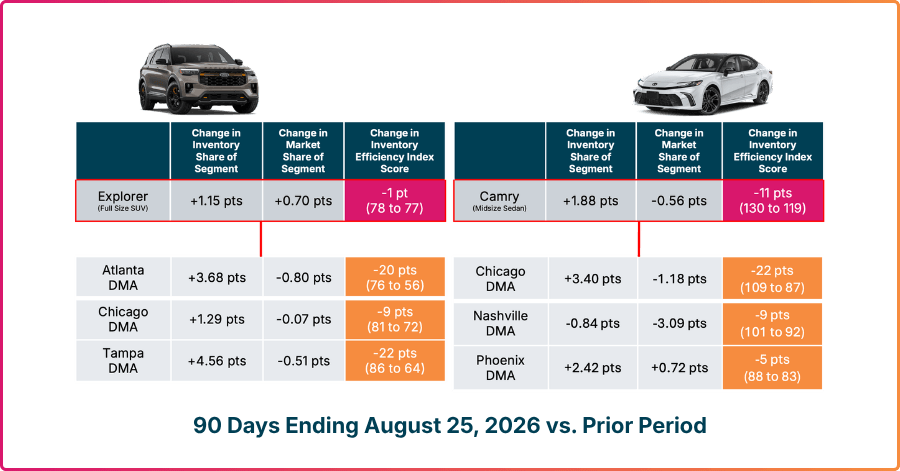
For example, Explorer's national IEI score is 77, but the story becomes even more relevant when you look at individual markets.
In Chicago, its IEI has fallen 22 points, from 109 to 87. Nashville is down 9 points to 72, while Phoenix is down 5 to 64. Camry shows similarly dramatic local variation. Its IEI score has declined 20 points in Atlanta and 22 points in Tampa, compared with a 9-point decline in Chicago. In all three DMAs, its IEI score now falls below the 100 benchmark.
→ Ford dealers don’t simply know that Explorer needs help. They can begin to understand how much more help Explorer needs in their specific market.
→ Toyota dealers don’t simply know that Camry's trajectory has softened. They can see where that softness is most pronounced.
The broader market tells you how a vehicle is performing overall. Local market data tells you where the biggest opportunities and challenges are.
There is one more level of precision, and it’s the most important one.
But even that isn't the end of the story. Because two Explorers—or two Camrys—sitting next to each other on the same lot do not necessarily represent equal sales scenarios. That's where VIN-level intelligence comes in.
VINScore takes precision all the way down to the individual vehicle, where factors such as color, equipment, pricing, days-on-lot, and other vehicle-specific characteristics can influence how difficult a particular VIN may be to sell.
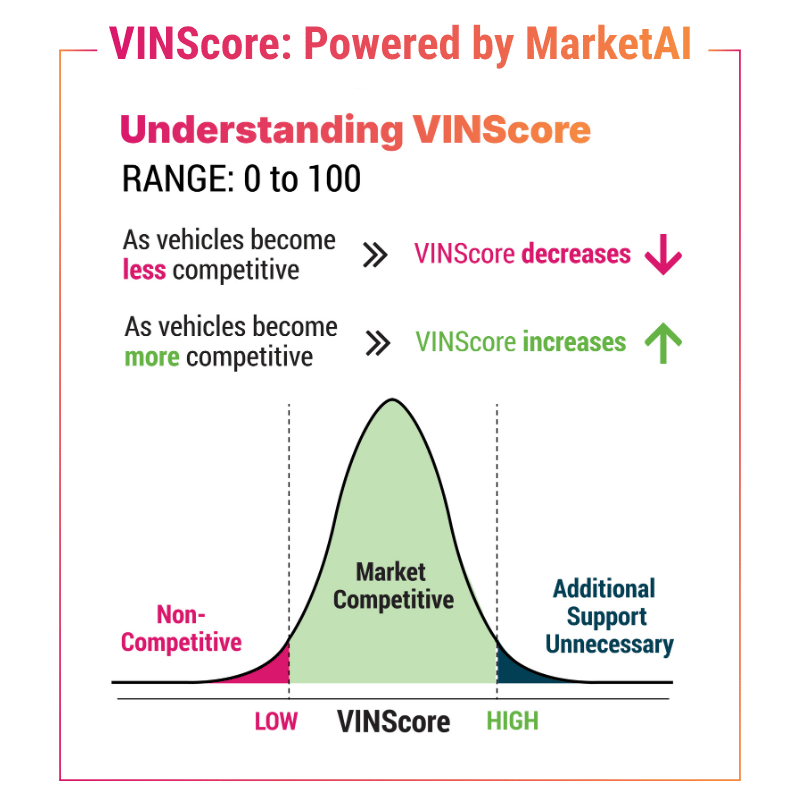
One Explorer may be positioned to sell with relatively little help. Another may have characteristics that make it harder to move. The same can be true of two Camrys sitting on the same lot. They may be the same model. They may even be similarly priced. But they aren't necessarily equally marketable.
And that's where the idea of precision marketing really comes to life.
When you stop asking, "How much should I spend marketing Explorers?" and start asking, "Which individual vehicles need my marketing dollars most?" your marketing becomes more targeted, more efficient, and more likely to drive results.
As Labor Day approaches, the goal isn't to market every vehicle the same way. It's to identify which vehicles need the most support and focus your marketing dollars where they can have the greatest impact.
Want to see which VINs on your lot may need additional marketing support this Labor Day weekend and beyond?
Schedule a free demo to see how VINScore helps dealers identify opportunities at the individual vehicle level and make more informed marketing decisions.

About Catalyst IQ
Catalyst IQ is an integrated automotive marketing agency that helps dealerships make smarter decisions and sell more cars using real-time data, AI-powered insights, and expert human support. From digital advertising and web presence to SEO/AEO and engagement, every solution drives measurable growth.

Long before they reach your lot, shoppers are seeing your inventory in ads and searching for answers online. This guide shows how digital...

Model Year Changeover season is here. And for dealers, waiting to support 2026s could come with a significant price tag. We are officially...

No one can tell you what your dealership's marketing will cost before looking at your market. What you spend depends on your local competition,...