
 Rick Wainschel, VP Data Science & Analytics
Automotive Marketing Solutions: Digital Advertising and SEO
Long before they reach your lot, shoppers are seeing your inventory in ads and searching for answers online. This guide shows how digital...
The new vehicle market is approaching record pricing territory, and this recent trend is different.
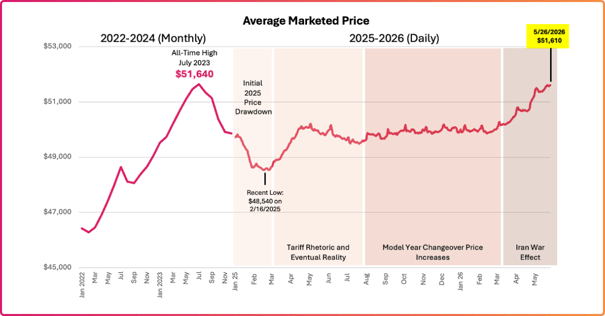
Catalyst IQ’s Average Marketed Price (AMP), which reflects the prices consumers actually see on dealer vehicle detail pages and inclusive of discounts and listed incentives, is approaching an all-time high—reaching $51,610 on May 26, just $30 below the record level seen in July 2023.
Importantly, the market reached this milestone rapidly. Over the past year, AMP has increased by $1,896 overall. Remarkably, $1,565 of that increase has occurred since March 1 alone, meaning more than 80% of the market’s recent price growth has taken place in just the past several weeks. Additionally, this jump is more structural rather than tactical, with more enduring MSRP increases driving levels upward.
At the same time, gasoline prices have also climbed sharply, creating a second layer of affordability pressure for consumers already facing historically elevated vehicle costs. Taken together, the result is notable: both the cost of purchasing and operating a new vehicle are approaching record territory simultaneously.
In addition to record vehicle prices, the national average of gas prices reached $4.33 for the week ending May 18—up almost $1.50 per gallon in eleven weeks and also approaching an all-time high.
In approaching a new all-time vehicle pricing high, several of its most important segments are driving this overall trend. Over the past several days, four major vehicle categories reached all-time highs in Average Marketed Price:
Full-size trucks
Full-size SUVs
Heavy-duty trucks
Luxury midsize SUVs
These are not fringe categories or low-volume niche vehicles. They represent some of the most important segments in the industry—both in terms of consumer demand and dealer profitability.
They also happen to include some of the market’s most expensive and fuel-intensive vehicles. Full-size trucks and SUVs remain among the most important volume and profit drivers in the industry. Heavy-duty trucks continue to benefit from strong demand dynamics, while luxury midsize SUVs have become one of the most competitive and heavily shopped premium categories in the market.
In other words, these price records are occurring in segments that sit at the center of the modern automotive landscape—not at its edges.
Just recently, Catalyst IQ wrote about a broader transition occurring beneath the surface of the market: higher prices are increasingly being embedded into the MSRP itself, rather than being driven primarily by reduced incentives or tactical discounting behavior.
That distinction matters.
Importantly, the market’s latest price acceleration does not appear to be driven solely by temporary reductions in incentives or discounting activity. Historically, elevated prices could often be reversed relatively quickly through implementing more aggressive offers. But MSRP-driven increases behave differently. They reset pricing baselines and residual values and tend to be far more durable over time.
What we are seeing appears consistent with that broader trend. These are not simply temporary pricing spikes caused by short-term inventory shortages. Increasingly, they reflect a market where higher pricing has become more deeply embedded into the structure of the industry itself.
For dealers, this creates a more nuanced and challenging operating environment.
Higher prices can support grosses and strengthen revenue performance, but they also raise the stakes around inventory management and consumer targeting. Not every configuration, trim, or price point will behave equally well in a market where affordability pressure is intensifying.
At the same time, elevated fuel prices can alter shopping behavior quickly and unevenly across segments, regions, and even specific VIN configurations.
That makes precision increasingly important.
The challenge is no longer simply understanding whether prices are high. It is understanding:
1. Audit price position — then act surgically
As pricing rises, not every VIN requires the same strategy. Use VIN-level market intelligence to identify which vehicles remain competitively positioned and which are beginning to face price resistance. Protect margin where demand supports it, while making targeted adjustments only where needed.
2. Use lower-priced new, used, and certified inventory as affordability release valves
As vehicle prices climb, a focus on more affordable models and trims informs consumers that there are still accessible choices to consider (see list below*). Additionally, used and certified inventory can become increasingly important alternatives for payment-sensitive shoppers. Dealers that strategically position vehicles that are within the means of a larger proportion of consumers can be better positioned to preserve volume and retain consumers who are stretching on affordability.
3. Protect volume by strengthening top-of-funnel visibility
In higher-priced segments, shoppers often take longer to make decisions and compare more options before converting. Maintaining strong upper-funnel visibility helps ensure your dealership stays in the consideration set without relying too heavily on broad discounting.
4. Rebuild the message around total value, not just sticker price
As affordability pressure increases, consumers look beyond monthly payments alone. Reinforce ownership value, capability, warranty coverage, fuel efficiency, and real-world usefulness consistently across digital advertising and vehicle detail pages.
5. Expand reach selectively based on demand signals
Broader geographic or platform expansion can create opportunity—but only when supported by data. Use localized demand and inventory insights to identify where incremental reach is most likely to drive efficient results.
6. Monitor market resistance and adjust quickly
In a fast-moving pricing environment, conditions can shift rapidly by segment, geography, and even individual configurations. Dealers that regularly evaluate pricing position, demand signals, and inventory efficiency will be better positioned to respond before resistance turns into aging inventory and wasted spend.
In appealing to affordability-minded shoppers, here are thirty new vehicles with Average Marketed Prices of less than $35,000 and inventory levels of 5,000 or more:
Buick: Encore GX, Envista
Chevrolet: Bolt, Equinox, TrailBlazer, Trax
Ford: Escape, Maverick
Honda: Accord, Civic, HR-V
Hyundai: Elantra, Kona, Sonata, Venue
Jeep: Compass
Kia: K4, K5, Seltos
Mazda: Mazda3, CX-30
Nissan: Altima, Kicks, Rogue, Sentra
Subaru: Crosstrek
Toyota: Corolla, Corolla Cross
Volkswagen: Jetta, Taos
The recent surge in vehicle pricing may prove notable not just for its record high and the speed in which it arrived there, but for its durability.
While market conditions will continue to fluctuate, the industry increasingly appears to be shifting toward a pricing environment where higher costs are becoming more deeply embedded rather than temporarily inflated.
In that kind of market, the advantage increasingly shifts to dealers that can use data and precision marketing to quickly identify where demand remains strongest, where affordability pressures are emerging, and which opportunities are most actionable in real time.

About Catalyst IQ
Catalyst IQ is an integrated automotive marketing platform that helps dealerships make smarter decisions and sell more cars using real-time data, AI-powered insights, and expert human support. From digital advertising and dealership web presence to SEO and AEO for dealerships, and engagement, every solution works together to drive measurable growth.

Long before they reach your lot, shoppers are seeing your inventory in ads and searching for answers online. This guide shows how digital...

Model Year Changeover season is here. And for dealers, waiting to support 2026s could come with a significant price tag. We are officially...

No one can tell you what your dealership's marketing will cost before looking at your market. What you spend depends on your local competition,...