
 Rachel Stokes, Director of Digital Advertising
How Should Auto Dealers Adjust Inventory and Pricing in Q4 2026?
Buyers kept buying in Q3, but new vehicle prices hit a record $52,770 and the average loan stretched to 69.5 months. See where demand is moving,...
Picture one campaign that puts your inventory in front of in-market shoppers whether they're searching a specific model, watching a walkaround video, or scrolling through Gmail. That's the promise of Google Performance Max.
Google Performance Max is a goal-based Google Ads campaign that runs across all of Google's channels from one setup. Rather than build separate campaigns for Search, Display, YouTube, Gmail, Discover, and Maps, you give Google your assets, your budget, and a goal such as leads or sales, and its machine learning decides where and when your ads run to reach that goal.
Google decides the placement mix, so your results depend heavily on the inputs and signals you feed it. So, the real question for a dealer is not whether to run Performance Max, but how to steer it.
Google Performance Max runs on three things you provide:
Google's machine learning takes those inputs and decides which ad to show, to whom, and on which channel, then bids for each auction automatically. However, Performance Max can only move the right cars if you steer it with the right inputs.
Performance Max is used in a variety of industries, so it’s important dealers use what works best for the automotive industry.
Performance Max matters for three reasons specific to your store:
That last point is where most dealers leave value on the table. Performance Max can move the right cars, but only if you steer it with accurate, current inventory data. MarketAI shows dealers in real time which vehicles are aging, which are in demand in your market, and where each shopper should land, so we feed Google inventory data that reflects your lot today.
Performance Max will always spend your budget. The question is whether it spends it on the cars you need to move. Left on its defaults, it optimizes for the easiest conversions, and for a dealership that usually means the vehicles that were going to sell anyway due to high demand.
On your lot, that plays out three ways. Budget chases your winners, so the models already flying off your lot get more support while your aging units get none, and without a feed pointing to live vehicle detail pages, shoppers can land on a generic homepage instead of the car they wanted. On top of that, automated reporting makes it hard to see which inventory and placements are actually driving results.
Unsteered, a Performance Max campaign follows Google's priorities, not yours. So it’s critical you feed the algorithm the data that makes the campaigns work for your business goals.
At Catalyst IQ, we don't hand Google our client’s budget and hope for the best. We feed the algorithm accurate, current inventory data from our MarketAI platform, so it works toward your goals. Here's how we do it.
The result is a campaign that reflects your priorities. Google is still running the auctions and finding the placements, but we maintain control on where the budget goes and which cars it works to move.
Performance Max reports on clicks, conversions, cost per conversion, and other performance metrics. But compared with traditional Google Ads campaigns, it provides limited transparency into which placements, channels, assets, audiences, and search queries are driving results.
Inside Google Ads, you can see a few high-level metrics: Conversions like calls, form submissions, and VDP visits, plus your cost per conversion and your impression share in the market. These confirm the campaign is producing activity, but they don't show whether that activity moved the vehicles on your lot, which is the question that matters most to a dealer.
To answer that, you have to look past the campaign and at the lot itself.
At Catalyst IQ, we don't stop at Google's campaign metrics. We measure whether your spend moved inventory, using automotive marketing data refreshed every day.
MarketAI's Campaign Analytics view puts your spend and your inventory movement in one place. You see how many vehicles your ads reached, how many of those moved off the lot, and what you spent, all updated daily instead of 30 to 60 days later.
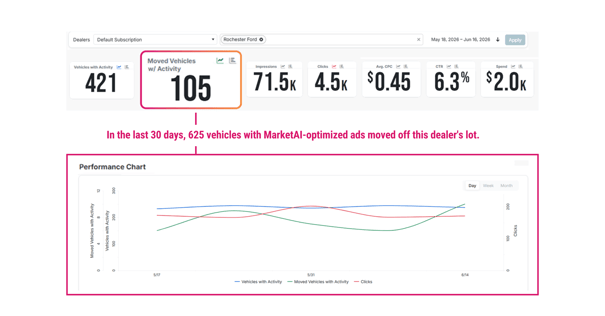
Moved vehicles with activity tell you the campaign reached the cars you needed to sell, so you can see your ad spend and your inventory movement in the same view instead of guessing at the connection. Seeing spend and movement together is what gives you transparent budget control over your Google campaigns.
Performance Max campaigns are wasteful if you don't feed them the right data. In a live 20-minute demo, we'll show you the inventory and movement data for your market that gets the best results from the campaigns you're already running, and how MarketAI keeps your ad spend tied to the vehicles you need to move.

A Search campaign shows text ads only on Google search results when someone types a query you're bidding on. Performance Max runs across Search plus YouTube, Display, Gmail, Discover, and Maps from one campaign, and its machine learning decides placement and bidding. For a dealer, Search is precise but narrow, while Performance Max reaches shoppers across more of their buying journey.
Vehicle Listing Ads are a specific format that shows a photo, price, and details of individual vehicles from your inventory feed. Performance Max is the broader campaign type that can include those listings while also running text, image, and video ads across Google's other channels. Many dealers run both, with Vehicle Listing Ads driving inventory-specific traffic and Performance Max widening the reach.
Yes, but not on default settings. By building a page feed around your vehicle detail pages and layering in inventory data, you can steer the campaign toward specific units and send shoppers to live, in-stock vehicles instead of a generic homepage.
Google Discover is the personalized feed of articles and content that appears in the Google app and on Android home screens. Performance Max can place your dealership's ads in Discover automatically, alongside Search, YouTube, Gmail, and Maps, so a shopper browsing their feed can still see your inventory without actively searching for it.

About Catalyst IQ
Catalyst IQ is an integrated automotive marketing agency that helps dealerships make smarter decisions and sell more cars using real-time data, AI-powered insights, and expert human support. From digital advertising and web presence to SEO/AEO and engagement, every solution drives measurable growth.

Buyers kept buying in Q3, but new vehicle prices hit a record $52,770 and the average loan stretched to 69.5 months. See where demand is moving,...

Long before they reach your lot, shoppers are seeing your inventory in ads and searching for answers online. This guide shows how digital...

Model Year Changeover season is here. And for dealers, waiting to support 2026s could come with a significant price tag. We are officially...