
 Rick Wainschel, VP Data Science & Analytics
Record Prices Rise as Incentives Lose Influence
Dealers and OEMs are pulling back on incentives to protect profitability, but the expected impact on vehicle sales isn't showing up in the data....
New-vehicle prices have reached yet another milestone. Average Marketed Price hit an all-time high of $52,306 on August 5, continuing its climb into record territory.
It would be easy to attribute rising prices to factors such as less aggressive incentives, and there is clearly a connection.
But our data suggests a more nuanced story: The industry is becoming much more disciplined with incentives, while consumers are continuing to buy—and the relationship between discounts and vehicle turn is changing.
The shift toward less aggressive market adjustments isn't happening at the margins, it's widespread.
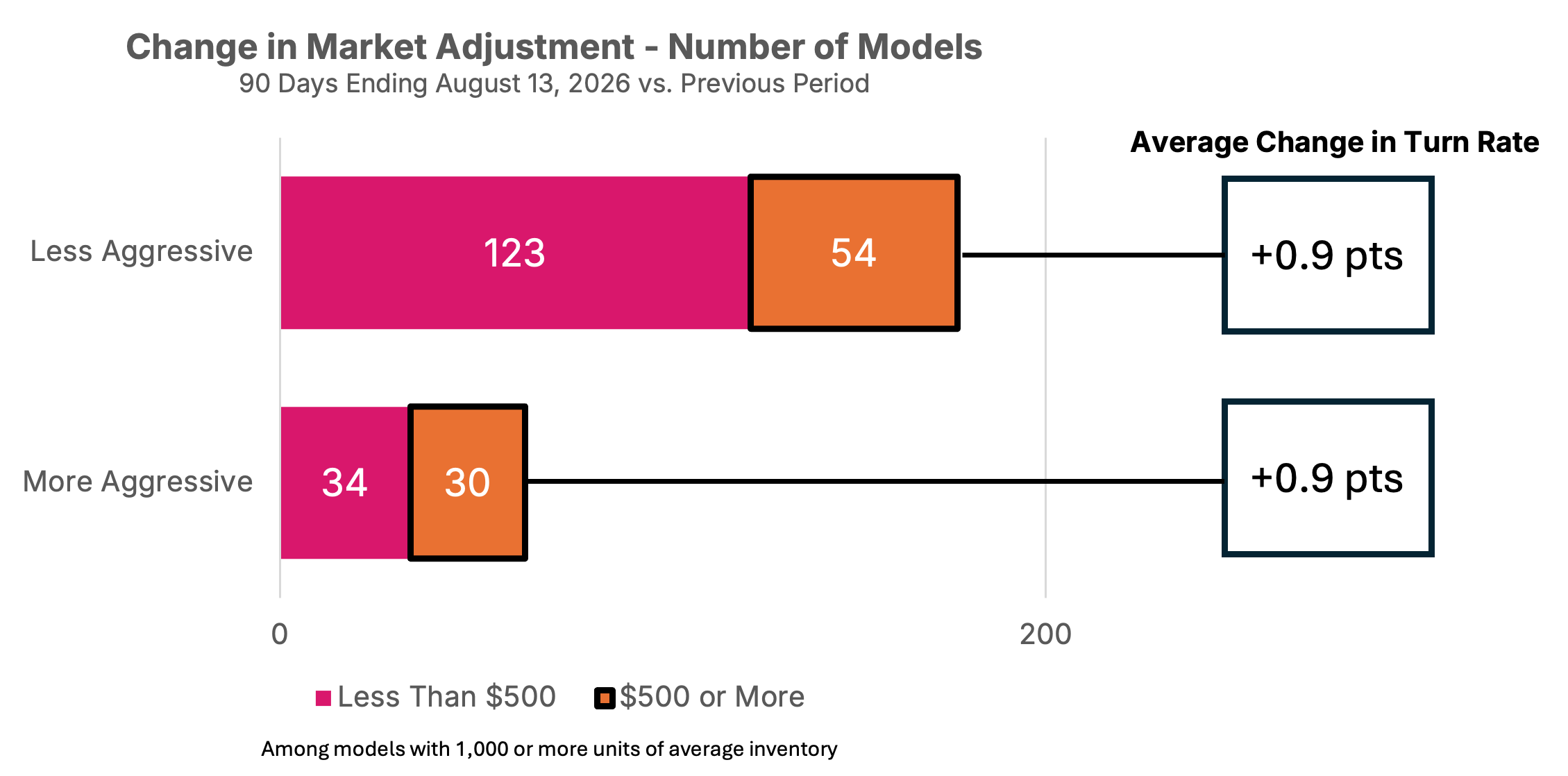
Over the past 90 days, 177 models became less aggressive in their market adjustments, compared with just 64 that became more aggressive, nearly a 3-to-1 imbalance.
And when we isolate the more meaningful $500-or-more changes, the direction remains clear: 54 models became less aggressive versus 30 that became more aggressive, nearly a 2-to-1 ratio.
That scale matters. This isn't simply a handful of OEMs or dealers experimenting with lower discounts. The industry is broadly applying greater discipline to incentives.
There are understandable reasons for these shifts. OEMs and dealers are operating under significant profitability pressure from inflation, tariffs, higher production and transportation costs, and geopolitical uncertainty.
Higher MSRPs and less aggressive incentives are one strategic way the industry is working to protect margins. General Motors, for example, has explicitly emphasized discipline around inventory, pricing, and incentives as part of its effort to maintain profitability.
The widespread pullback in incentives raises an important question: Is less discounting making vehicles harder to sell? The surprising part: incentives aren't moving turn rates like they used to.
Over the past 90 days, models where market adjustments became $500+ more aggressive saw their average turn rate improve by 0.9 percentage points; meanwhile, models where market adjustments became $500+ less aggressive saw their average turn rate…improve by 0.9 percentage points.
The result was identical.
That doesn't mean incentives don't matter. They can absolutely influence a consumer's decision. But it does suggest that changing the incentive level is not, by itself, producing a meaningfully different turn-rate outcome across the market right now.
Something else is driving the sale: The vehicle itself, its price point, its segment, its availability and how well it aligns with what consumers want right now.
The widespread pullback in incentives and discounts isn't happening in isolation. OEMs are under pressure to find cost efficiencies, manage tariffs and other geopolitical uncertainties, and protect margins. Incentives are an obvious place to exercise discipline—but they're only one part of a much broader effort to manage profitability.
We're seeing OEMs respond in different ways.
General Motors has emphasized lean inventory, strong pricing, and disciplined incentives.
Nissan is increasing U.S. production, helping reduce its exposure to tariffs and global supply-chain pressures.
Hyundai is adjusting model and trim mix with a greater emphasis on more accessible offerings, while also working to improve its U.S. production footprint and cost structure.
The approaches vary, but the objective is remarkably consistent: Find ways to absorb higher costs and protect profitability without simply throwing more money at incentives.
And that matters because incentives aren't the only thing changing.
Consumers are still buying, but they can't simply be bought with a discount. In a market where blanket OEM incentives are fading, dealers can no longer rely on slashed prices alone to move metal.
To protect margins, dealerships must shift their focus from the size of the discount to the power of the placement.
This environment demands a strategic pivot to precision marketing across four critical pillars:
Strategic Placement: Dealers must ensure their specific vehicle inventory is positioned front and center where active shoppers are looking.
Audience Alignment: Marketing efforts must target the right vehicle to high-intent buyers who are already statistically likely to purchase it.
Compelling Narrative: Digital merchandising must effectively "tell the story" of that inventory—highlighting the exact features, options, and unique benefits that justify the vehicle's price point.
Channel Relevance: Dealerships must meet consumers where they are by leveraging tailored marketing tactics—such as using video for visually inclined shoppers or deploying paid search for high-intent action takers.
Record prices may be the headline. But the real story is that the industry is learning it can't simply buy demand with discounts anymore.
In this disciplined market, precision marketing has a far better chance to supersede broad discounting as the ultimate driver of inventory turn.

About Catalyst IQ
Catalyst IQ is an integrated automotive marketing agency that helps dealerships make smarter decisions and sell more cars using real-time data, AI-powered insights, and expert human support. From digital advertising and web presence to SEO/AEO and engagement, every solution drives measurable growth.

Dealers and OEMs are pulling back on incentives to protect profitability, but the expected impact on vehicle sales isn't showing up in the data....

Digital Dealer moves to Detroit this year, September 22-23 at Huntington Place. Here's how to spend your time so you leave with helpful insights (and...

Every car on your lot is doing one of two things: Moving or costing you money. Moving aging inventory faster protects your margin, and these four...